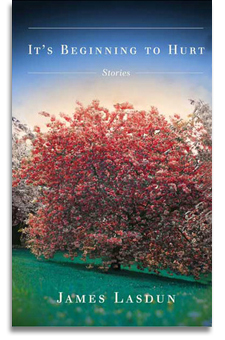
 “James Lasdun proved himself to be a master of the form with the enthralling psychological subtleties of It’s Beginning to Hurt.” — Geoff Dyer, The Guardian
“Every story is heart-poundingly vivid. Mr. Lasdun’s characters live in the here and now. . . . He instinctively understands human psychology, and it seems as though he can turn anything into a story.” — The Wall Street Journal
“Lasdun, in his third collection, inhabits his characters with the seemingly effortless sympathy of the gifted realist writer. Several of the stories are masterpieces.” — Kevin Power, The Irish Times
“Spellbinding . . . James Lasdun may single-handedly save British short fiction from an untimely demise.” — Taylor Antrim, The Daily Beast
“James Lasdun has the uncanny ability to conjure up ordinary lives with extraordinary perception. Without hyperbole, hysteria, or even profound drama, he creates fascinating, compelling characters who are richly complex, yet generally not so different from you and me… With prose that is stunningly clear, direct, and incisive, he gives us a series of startling, provocative snapshots that resonate well beyond the page.” — Karen Campbell, The Boston Globe
“This exquisite collection of short stories illuminates the everyday agonies of the mind, its anxieties, obsessions, doubts, and yearnings. . . . Lasdun pins each observation to the page with grace and exactitude.” — Benjamin Schwartz, The Atlantic
“[The] characters have a complexity and confusion that override the unfolding plot. And the narratives seem opened up to the entire history of fiction . . . Touching and revelatory . . . Devastating.” — Mark Kamine, The Times Literary Supplement
“[A] marvelous, masterful collection.” — Lizzie Skurnick, Los Angeles Times
“Reading Lasdun is like reading a sly collaboration between Kafka and Updike: elegant, acutely observed and utterly unflinching . . . This is a collection that examines the most inward mechanisms of rage, fear and desire with astonishing skill and strangely lyric power.” — John Burnside, The Times (London)
“Lasdun has a Nabokovian eye. Few exponents of the short form offer such tempting, disturbing pleasures . . . It’s Beginning to Hurt is . . . a superlative collection, exhibiting all of Lasdun’s familiar talents and a few new ones into the bargain.” — Richard T. Kelly, Financial Times
“[Lasdun] create[s] a world of objects and feelings that are rich, recognisable and yet elusive . . . His prose [here] is marked by a thoughtful, humane exactness . . . Lasdun uses his dramatic skill to show the most subtle and delicate movements between poles of feeling.” — Tom Deveson, The Sunday Times (London)
“Like such masters of dark literature as Edgar Allan Poe and Franz Kafka, Lasdun limns the deep cracks in the soul even as his tales are enlivened by his gift for insight and ear for language. His stories are a fury of elements: skilled dramatic monologues; sketches of fraught emotional states . . . [which] are shot through with crafted verse . . . Masterful.” — Susan Comninos, The Miami Herald
“There is much to admire in Lasdun’s stories, not least the astonishing beauty and precision of his imagery. In a few perfectly chosen words, Lasdun can distill a character’s essence and bring him to life.” — David Bezmozgis, author of Natasha
“[This] stellar collection combines a sharp eye for detail, subtle character development and virtuosic command of narrative voice . . .” — Kirkus Reviews (starred review)
“As he proved with Seven Lies, Lasdun is an elegant and incisive student of the human mind—an author who can register exactly when, for a character, ‘it’s beginning to hurt.’ This remarkable collection shows what happens when we break through the gauze of everydayness and existential panic hits. . . Affecting, yes; sentimental, no. Hard-edged truths about our predicament poke through this work, which is highly recommended.” — Barbara Hoffert, Library Journal (starred review)
“[This] collection packs a devastating punch. Lasdun peels back the facades of middle-aged, middle-class types through their run-ins with cancer, infidelity and loss that lead them to deal with unexpectedly large and often ugly recognitions . . . Jewels of resignation and transformative personal disaster, these stories are written so simply and cleanly that the formidable craft looks effortless.” — Publishers Weekly (starred review)
“James Lasdun is probably the closest thing in recent years this country has come to a genuinely great practitioner of the short story.” — Guardian (UK)
ATLANTIC MONTHLY BEST FIVE BOOKS OF 2009
WALL STREET JOURNAL BEST FICTION OF 2009
LIBRARY JOURNAL BEST BOOKS OF 2009
LOS ANGELES TIMES FAVORITE FICTION OF 2009